

I recently had the good fortune of meeting Abraham Lincoln. Okay, okay. It wasn’t the real Abe. But he was a remarkably good lookalike who clearly has a great side gig on the DC event circuit where these pics were taken.
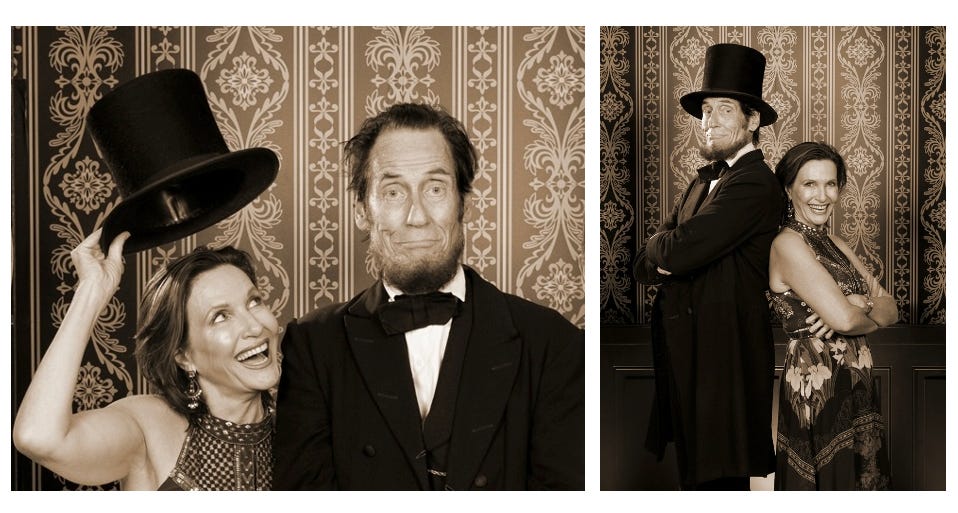
Long before I had the privilege of living in America, I admired Abraham Lincoln. Few leaders have overcome more adversity or met it with more courage.
Born in a log cabin on the Kentucky frontier, he lost his mother at nine, had less than than a year of formal education, spent years repaying the debts of a failed business, buried two young sons and battled such severe depression that friends feared for his safety. And after several defeats at the ballot box, he became president of a nation at the very moment that it was tearing itself apart.
In December 1862, with the Civil War going badly, he wrote in his annual message to Congress:
“The dogmas of the quiet past, are inadequate to the stormy present. The occasion is piled high with difficulty, and we must rise with the occasion. As our case is new, so we must think anew, and act anew. We must disenthrall ourselves, and then we shall save our country.”
Not defeat them. Disenthrall ourselves.
The word “thrall” comes from Old Norse, meaning a slave or serf. To disenthrall is to set free from that bondage. Yet to be enthralled also means to be charmed by something we find captivating and compelling. And let’s face it, most of us think our take on the world is pretty compelling. We’re also very captivated by our take on ourselves.
Which is the trap we can all so easily fall into - being held captive to beliefs that feel so reasonable they become invisible to us. And the longer we hold onto them, the harder it is to see, much less admit, when they’re no longer moving us forward. And so we press on, trying to navigate a world we’ve never traveled before with a mental map that’s long since grown obsolete.
The beliefs that hold us captive are often the ones that feel most reasonable.
Add to this our deep aversion to loss, echoed in “better the devil we know than the devil we don’t”, and little wonder you can probably think of at least one person in your life who seems ‘blind to their own blindness’.
None of this would be a problem, except that in this “stormy” present, the cost of navigating from an outdated map - Lincoln’s “dogmas of the quiet past” compounds by the day.
I see it often. In execs who think they need to have all the answers to stay credible. In people trying desperately hard to spin more plates for fear of falling behind, and feeling increasingly off-kilter.
I also know it myself. Where I once felt that speed was the ticket to getting ahead, I now realize that it’s depth that’s needed far more. Less striving, more spaciousness; less polishing, more presence.
So how do we disenthrall ourselves?
It’s a funny quirk of the human condition that we can easily identify where others are captive to outdated beliefs. For ourselves? Not so much.
It’s also easy to argue that if people in high office were less enthralled by themselves, our lot in life would be a whole bunch better. But as with all meaningful change, it must begin within, with an honest self-audit of what’s working… and (more so) what’s not… that is pointing us to where we need to ‘disenthrall’ outselves.
If you’re regularly bumping up against the same problem (or problem people) in different guises, pay attention. Likewise, anytime you feel some modicum of “ho-hum”… that middle child between feeling outright depressed and fully ‘on purpose’… it’s pointing you toward an upgrade of your own mental map - to disenthrall yourself.
The hardest map to see is the one we hold of ourselves.
Of all the maps that shape our decisions, none holds more sway, or is harder to see, than the one we hold of ourselves. So many of my conversations lately, including with senior leaders navigating stormy times, come back to the identity they’re leading from. Often, they’ve grown over-reliant on the strengths that got them here, and over-identified with labels they, or others, have put on them. Past accomplishments may feed the ego, but they can also fuel a fear of not living up to them, stitching us into an invisible straitjacket that keeps us from the very actions that would improve our future
So if you ever feel the need to prove how well you’re doing, keep up appearances or avoid disapproval, consider it an invitation to look at where your identity is holding you captive, limiting both you and the good you might otherwise do.
Letting go of beliefs that have long made us feel secure is no small task. We are, after all, wired more for self-preservation than self-actualization, more for fitting in and looking good than for risking the dints on our ego required to do more good.
Don’t let your adversities define you. Let them refine you.
Lincoln knew this tension well. He suffered many defeats, but chose never to be defeated by them. I can’t imagine he would ever have become the leader he was had he not been so humbled by life. Rather than hardening him, his heartache and hardship refined him, deepening his faith and cultivating the wisdom needed to rise to the stormiest of moments.
We can all make the same choice - not to be defined by what tests us most, but to be refined by it.
Disenthralling yourself might mean having the honest conversation you’ve avoided for fear of the fallout. It may mean putting yourself “out there” in new ways - moving on, stepping up or starting over - despite the anxious voice in your head trying to talk you out of it.
Most of all, it requries refusing to be held “in thrall” to old stories that keep you from occupying the full size your life is asking of you.
Storms are swirling all over this planet. Chances are you have a few in your corner of it. If so, they’re issuing you the same invitation they offered Lincoln: to disenthrall yourself and choose to think, and act, anew.
So let me finish with two questions:
What belief, which once felt reasonable, is now restricting you?
And if you set it down, what might you do, and who might you become?
You don’t need to have all the answers before you begin. Neither did Lincoln who also said:
“Let us have faith that right makes might, and in that faith, let us, to the end, dare to do our duty as we understand it.”
As we understand it. Not once we’re certain. Not once we feel ready.
Dare to think, and act, anew.
If you’re up for it, I’d love to hear your answer to those two questions. Share it in the comments, or simply hit reply.
PS: Sometimes the best way to think anew is to step away from the familiar. Next year, I’ll be leading a group of women leaders on a six-month journey, including a week walking the ancient Camino de Santiago in Spain. If this calls to you, click below to learn more.

I believe we require a balance of self preservation and self actualisation. I hope the world can think and act anew in the present and for the two decades to come.