

My house was built in 1784. We moved in as renters in the middle of the pandemic, freshly arrived back in the US from Singapore and keen to just get our feet back on the ground.
Six months later, we bought it.
Not a small decision for a house of such vintage, in need of plenty of love (and dollars!). But its character won us over and so did its history.
Among its many owners was Dr. Elisha Cullen Dick, the youngest of the three doctors at George Washington’s bedside at Mount Vernon when he died, said to have stopped the bedroom clock at the moment of Washington’s death.
Over time, I’ve come to see myself less as an owner of my home and more as a steward of its history. And what I value most about living in a home that has witnessed so much is how it puts life into a larger frame of time.
Nowhere more than on my stairs.
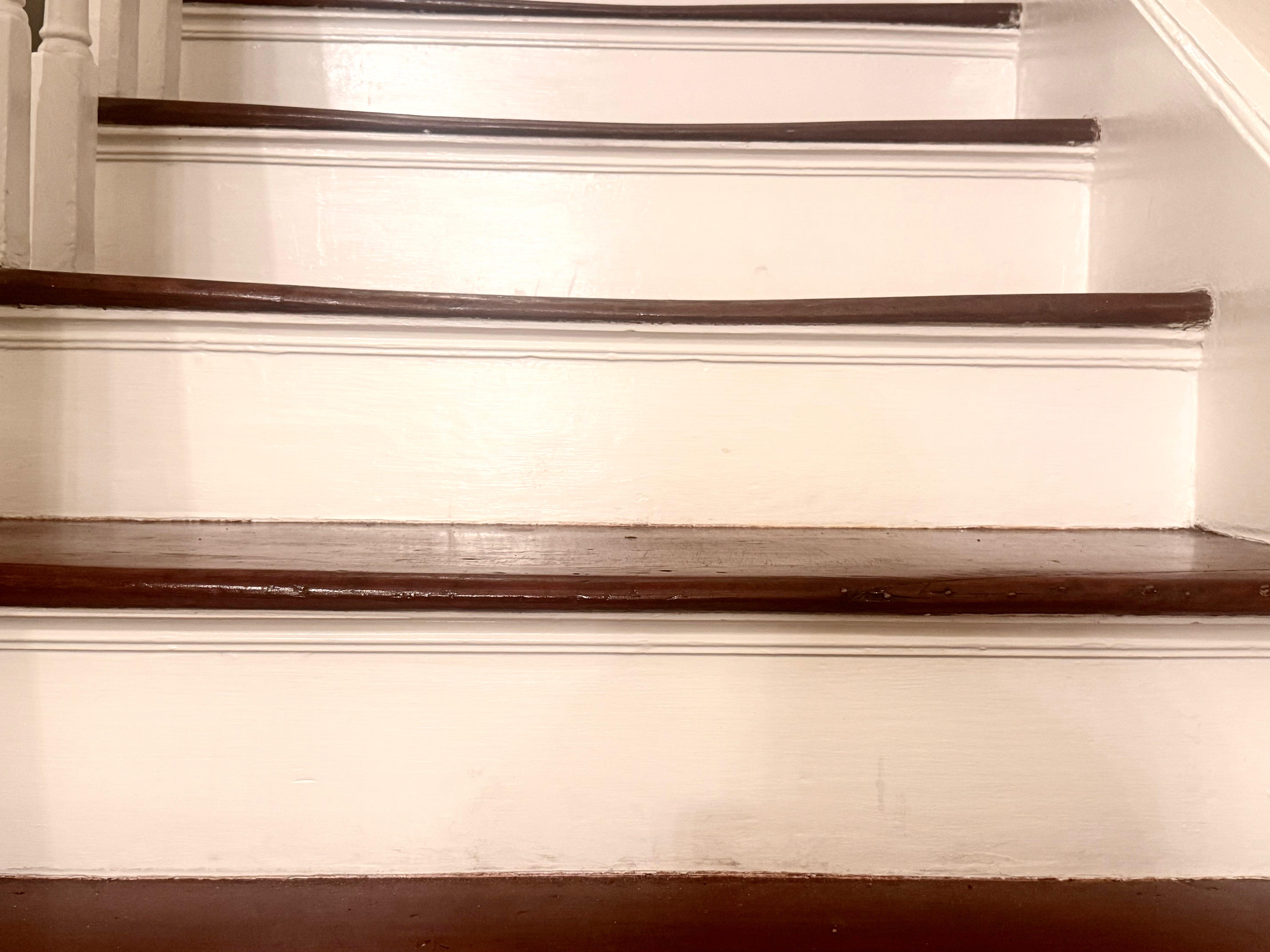
Made from the hardy heart pine, centuries of footsteps have worn a long groove across their center. Some days, as I go up and down, distracted by 101 concerns (most of them petty), I remind myself that people have been climbing these stairs for nearly 250 years, carrying plenty of their own worries.
And I suspect, that most of them felt their worries were greater than those of anyone who ‘d come before them. Just as we do today. Sure, Dr. Dick, who was also mayor of Alexandria, never had to worry about disruption from AI or the impact of social media on youth mental health. But in his day, nearly half of American children didn’t live to see five, and his most famous patient, George Washington, died of a throat infection that would easiy have been treated with antibiotics today.
Living in this old home has made me think a lot about our relationship with time, and how often and easily we get it wrong. We tend to overestimate how much our problems will matter over the longer arc of time. And we tend to underestimate our capacity to grow, to adapt and to meet them.
That first distortion - believing our moment is uniquely hard - feels especially relevent today as we’re constantly reminded that we’re living through a “moment like no other.” Of course, on one level, this is true. But wind the clock back even 25 years and you’d hear the same thing. And 25 years before that. And…
Every generation tends to think that it’s living through the hardest moment in human history.
And while zooming out from this moment doesn’t negate the reality of our challenges, or the enormous disruption of GenAI on every aspect of our lives, it does right-size them so we can stop agonizing over what lays outside of our control and focus our time, ingenuity and life force on what lies within it.
Which brings me to the second time distortion: assuming we have less capacity to adapt and rise to the moment than we actually do.
The term “end of history illusion” was coined by Harvard psychologist Dan Gilbert and others to explain why we can easily identify how much we’ve grown over the last decade but are consistently lousy at estimating how much we’ll change in the next.
We think that who we are now is the ‘final version’ of ourselves. Not true.
Working together, these two distortions often make us more anxious and less ready to take the very actions that would shape a better future.
Which brings me back to my stairs…
Or rather, to the people who’ve climbed them before me (possibly even Washington... according to the local realtor!). They too faced “moments like no other” - from the Civil War to the Great Depression. But they didn’t stay who they were. They adapted, got resourceful and grew into what their time demanded of them.
It’s not that our problems aren’t real. They are. Rather it’s that they are rarely as big as they feel, and we are bigger than we think.
Zoom out further still, and the same is true of humanity. These stairs were twenty years young when Alexander Hamilton was killed in a duel. Thankfully, society has come a long way since then in how we settle our differences. Or how we treat fellow human being. For much of my home’s first 80 years, enslaved people were bought and sold just streets away.
Does humanity still have a long way to go? Of course. Always.
But the long view shows how far we’ve come, and how much more we’re capable of than any single moment makes us think.
As the headlines pummel us with end-of-the-world-as-we-know-it news, we need to remember that this is just one moment in the long march of time. We would not be here at all if not for our capacity, individually and collectively, to rise to meet the moment that is being handed to us.
So whatever is weighing on your mind today, here are two questions to carry up the stairs with you:
Ten years from now, how much of what occupies your mind today will matter? What can you do today to act on what will?
If you trusted yourself to grow as much in the next decade as you have in the last, what would you stop waiting to do?
As my 91-year-old dad often says, “We’re all just passing through, Margaret Mary.”
Your worries are passing through too. And so is this current version of you that’s carrying them.
Worn stairs make for wiser steps.
So trust in the person you’re still on your way to becoming. Decisions made from a place of self-trust, not self-doubt, have a special way of leading somewhere better.
PS: Speaking of worn paths… next August, join me and a small group of purpose-driven women walking the final 115 km of the thousand-year-old Camino de Santiago pilgram path as part of a six-month coaching journey to help you trust who you’re becoming and take your next brave step. More info here

End of history illusion, perspective, resilience, courage, anxiety, personal growth, decision-making, future self, leadership, Old Town Alexandria