

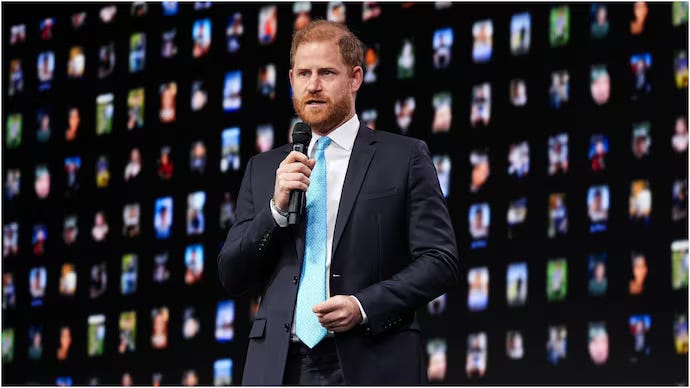
There was a stark irony on stage at the Clinton Global Initiative in New York last week. Prince Harry was midway through an impassioned warning about the dangers AI poses to children when - bam - his teleprompter went dark. He paced awkwardly for a few seconds (though I’m guessing they felt like very long seconds to him) before saying “And that’s it” and walking off.
When he returned about 40 minutes later to finish (teleprompter now working), he joked that AI had gotten into his speech.
I felt for him. Sort of. Freezing on stage in front of people we want to impress is the very reason so many people dread stepping onto a stage in the first place. But this isn’t about stage fright. It’s about what happens when we become over-reliant on technology. And not just younger people. All of us.
Psychologists coined the term “cognitive misers” to describe our brain’s tendency to default to whatever option takes the least effort. That’s always been true. What’s changed is that GenAI now offers an instant shortcut for almost every task that once required real mental effort.
The old maxim "If it sounds too good to be true, it probably is" is all too relevant here. GenAI promises all the answers with none of the effort.
But every muscle we stop using gets weaker. Our brains are no exception.
If you’re over fifty, you likely spent a lot of time learning your times tables as a kid. My dad made a competition among my siblings to see who could could get the most right. Working weekends in a take-out shop, and later at the local pub, sharpened them further, so by my twenties I could add up a dozen items and calculate the change (back when everyone paid cash) faster than the cash register. I can still out-calculate my kids (though hardly a boast, since their schooling didn’t focus on it), but I’m not as sharp as I once was. The reason? I do it far less.
Neuroscientists like to say that “neurons that fire together wire together.” The flip side is also true. Neural pathways left idle don’t just rest. They weaken, and the longer they lie dormant, the harder they are to bring back to life.
This principle applies to what we outsource to GenAI, including skills we’ve practiced for decades. One study of experienced physicians found that after AI detection tools were introduced, their ability to spot precancerous growths on their own dropped by about 20% within three months. Wow. This aligns with research from Boston Consulting Group showing that the skills most vital to long-term performance at work and leaderhip effectiveness are the very ones most at risk from AI. Topping the list: “judgment and decision-making” and “problem understanding and framing.”
These are the exact skills we need to decide when to use AI at all! In short, our reliance feeds on itself. The more we outsource our thinking, the more we need to. To state the obvious: this is not a good trendline.
Of course, we aren’t helpless victims of a technology fast permeating every corner of our lives. We have a choice in how much we use it - and how much we lose to it. But we need to be intentional in our choosing.
Once a task that took three hours takes 30 seconds (like writing an article or preparing a presentation), returning to the “old-fashioned way” requires more effort than if we’d never outsourced it at all. And because our brains are loath to work harder than needed, they’re little Einsteins at rationalizing why the faster option is the smarter one. Which is exactly why my kids accused me of being “so last century” for making them learn mental math when they had a calculator. Over time, choosing the harder path gets harder… and harder.
Choosing effort over convenience will rarely feel brave in the moment. Writing the email yourself. Working through a problem without the chatbot. But sometimes the braver choice isn’t a bold leap into the unknown.
It’s simply deciding to think for ourselves, even as we fear that the slower option may risk us losing ground to those moving faster.
It’s deciding to invest in the person we’ll be tomorrow at the expense of the time we lose today.
It’s why I’m writing this now. All.by.myself. Because the thinking we stop doing is the thinking we slowly lose. If we don’t deliberately keep using our brains when the shortcut is right there for the taking, we’ll find them harder to use when we really need them.
Don’t get me wrong. I’m not anti-GenAI. But…
As the world grows faster, messier and more complex, we need to protect our ability to think deeply, discern patterns, and make good decisions that draw on the human wisdom no algorithm can replace.
Harry’s teleprompter moment is a small version of the same trade-off. When we lean on the screen rather than building the words into our own heads, there’s nothing to fall back on when it goes dark. So rather than judge him (though perhaps you have and maybe I did too), let’s take the lesson for ourselves. Every shortcut we take casts a small vote for the brain we’ll have tomorrow.
My invitation in the week ahead:
Choose one thing you will do that requires more mental effort, not because it’s efficient, but because it will keep you sharp and honors the brain power you want to bring to your life, your leadership and the world.
And if there’s something you’ve already decided to keep doing yourself, even though AI could do it faster, I’d love to hear. Drop me a note. No AI required.
It's a great piece. Thought provoking too. As someone who has used and uses AI weekly and considering the current debates around Data Centres and their necessity in modern life I had already canvassed your ideas. I concluded I probably only REALLY needed to use it about 10% of the time I had been.
I caught myself using it find actors names or ages in movies I was watching with my wife of YouTube and I knew I had crept into "overuse".
So yeah, like any new technology there are going to be those who are circumspect and those who jump in "boots and all". The debt bubble and investment boom that is currently "life-supporting" the US Stock market is all about the Boots and All. It's grand technology is it not?